
Angelo David on the three questions retailers across Australia and New Zealand keep asking about retail media: legacy tech, siloed teams and data governance.
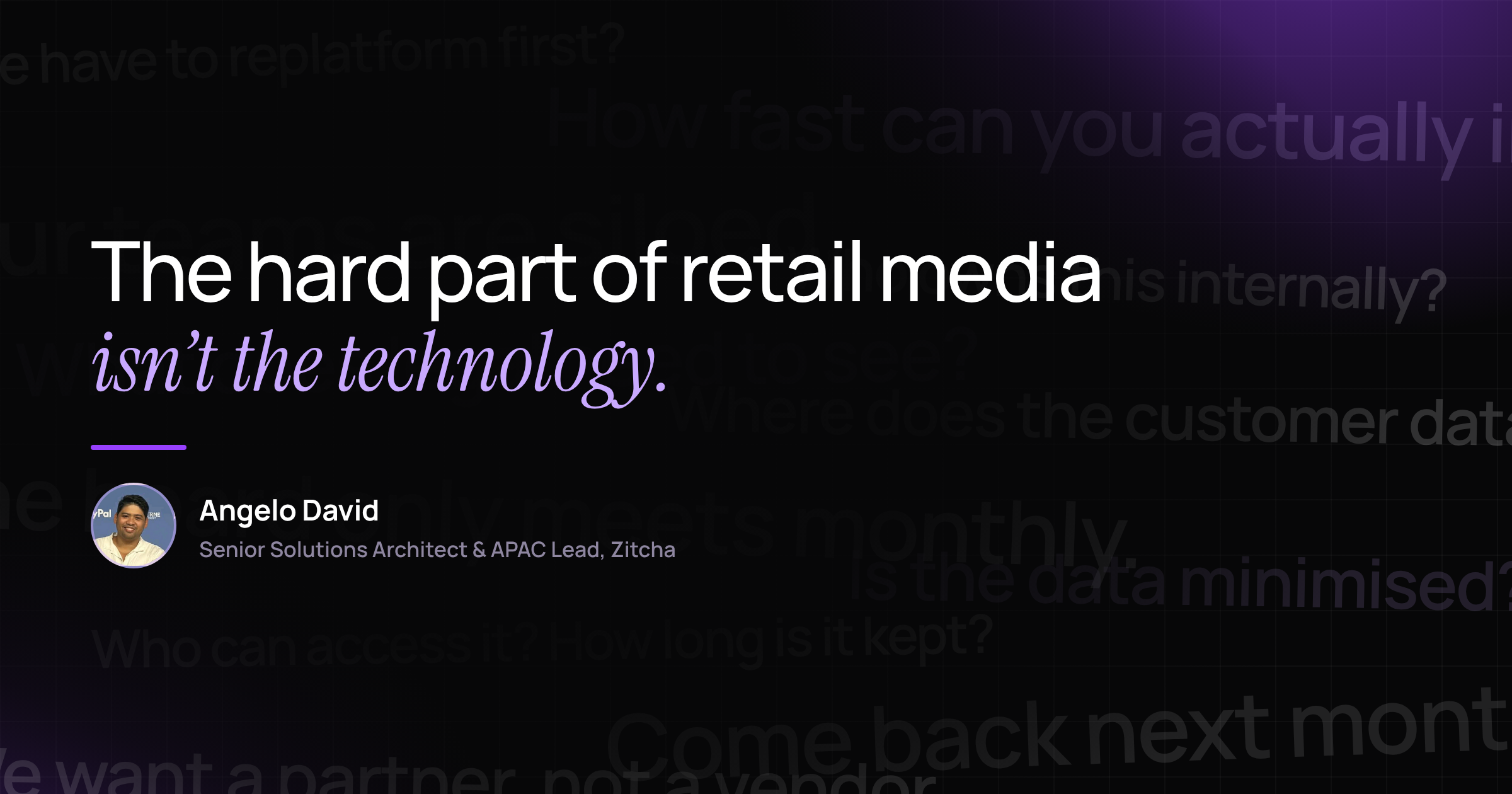
Angelo David on the three questions retailers across Australia and New Zealand keep asking — and why none of them are about features.
Retail media has moved from experiment to expectation. Most large retailers now accept they need a media network. The harder question is how to adopt the technology behind it without stalling the rest of the business.
I’ve seen that question from both sides. Early in my career I was on the vendor side, helping retailers keep their stores running through peak. Then I moved to the retailer side, working on in-store technology with Australian department store and specialty retailers. Today I work with retailers across APAC as they build and scale their retail media capabilities.
In the eight months I’ve been in this role, I’ve spoken with retailers across Australia and New Zealand in DIY, liquor, pharmacy and technology. The verticals are different, but the same three questions come up again and again.
None of these are about features. They’re about legacy, people and trust, and they apply to almost any enterprise technology.
Here’s what I’ve learned about each.
1. Legacy tech: stop waiting for the perfect stack
Every large retailer has an old stack. Commerce platforms from a decade ago, on-prem systems no one wants to touch, and an IT backlog that’s always full. When I was on the retailer side, a new integration meant another fragile connection into a system that already held peak trading together.
The mistake I see most often is treating modernisation as a prerequisite. Teams wait for the replatform, or try to integrate everything before anything goes live. Meanwhile the opportunity moves on.
The retailers who move fastest do three things differently:
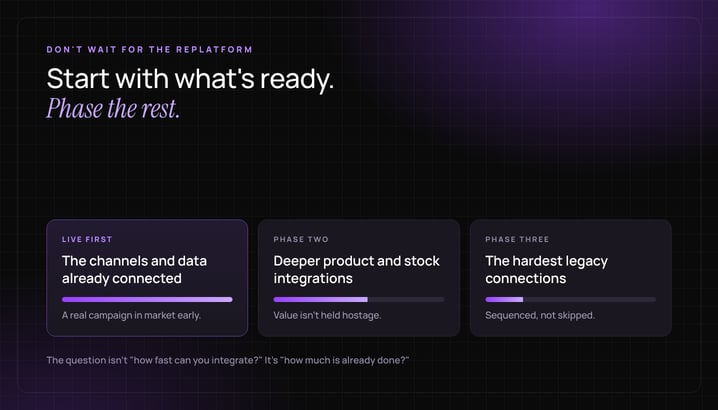
- They start with what’s ready. They connect the channels and data that are easiest now, and get a real campaign live early.
- They phase the rest. Deeper integrations follow in stages, so value isn’t held hostage by the hardest piece of work.
- They choose platforms built to connect. The less that has to be built from scratch, the less the legacy stack matters.
That last point is where the industry has moved most. Modern retail media platforms like Zitcha now have integration hubs: libraries of pre-built connections a retailer can switch on in a click. Adding a social channel or an in-store screen network becomes a configuration task, not an IT project.
That only works when the platform has done the partnership work upfront. In my view, two things separate the leading retail media platforms from the rest:
- Deep partnerships across every channel. Onsite (search, product listings, display), offsite (social, programmatic, CTV) and in-store (screens, audio, physical media). The more of that ecosystem already connected, the less your team has to build.
- Openness by design. Open APIs, webhooks and, increasingly, MCP (Model Context Protocol) let retailers connect their own systems, data and AI agents without waiting on a vendor’s roadmap. A platform that can’t plug into what you already run just becomes another silo.
For a retailer with an old stack, this changes the question. It’s no longer “how fast can you integrate?” It’s “how much of the integration has already been done?”
An experienced solutions team should be able to show you what can go live first, and the plan for the rest, after one discovery session.
2. Silos: software doesn’t change organisations, people do
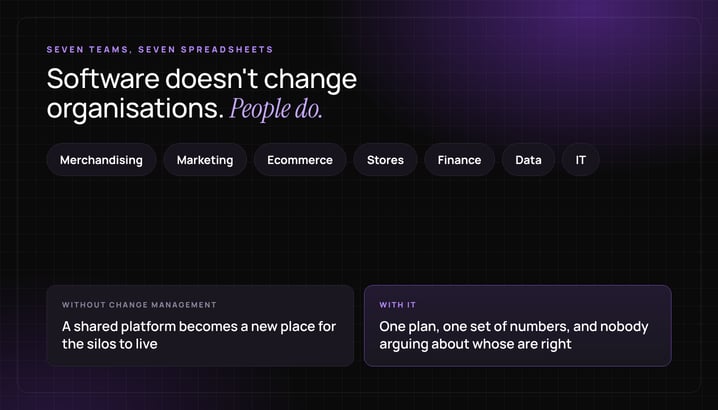
Retail media cuts across more teams than almost any other function. Merchandising, marketing, ecommerce, stores, finance, data and IT all have a stake, and each has its own priorities, spreadsheets and version of the truth.
A shared platform helps. When planning, bookings, reporting and billing sit in one place, teams stop arguing about whose numbers are right.
But I’ve seen plenty of good software land in a siloed organisation and simply give the silos a new place to live.
What actually shifts behaviour is change management, done deliberately:
- Map the people before the processes. Who is affected in each team, and what does success look like for them?
- Train by role, not by feature. A merchant, a campaign manager and a finance analyst need very different things.
- Measure adoption, not just uptime. Check-ins after go-live should focus on who’s using it and what’s changed.
- Borrow what’s worked elsewhere. Playbooks from other retailers and markets save months of trial and error.
This is why retailers keep asking for a partner, not a vendor. A vendor delivers the software. A partner tells you when a process isn’t working, and helps you fix it, even when the fix has nothing to do with their product.
It’s the same point my colleague Steve Biddle makes about how merchants see retail media: shared commercial outcomes, not shared software, are what bring teams onto one plan.
3. Governance: make the champion’s job easier
This is the question I respect most. It usually comes from the person inside the business who wants to champion the change, and who now has to take it through security, privacy, legal, procurement and architecture review.
I’ve been that person. You spend weeks relaying questions between reviewers and the vendor while momentum quietly drains away. With first-party customer data at the heart of retail media, the scrutiny is only getting tighter, and it should.
In my experience, two gates decide most timelines.
As privacy expectations rise in Australia and New Zealand, the DPIA is often the first thing a privacy team asks for. And even with a clean one, the board still wants to know the use case is appropriate and the controls will hold.
Our team has taken retailers through both, more than once. Here’s what gets approvals over the line:
- Do the DPIA groundwork alongside them. Arrive with data-flow diagrams, a clear data inventory and answers on retention, access and de-identification, so the privacy team is reviewing, not discovering.
- Design for data minimisation from day one. Keep customer-level data inside the retailer’s environment and share only aggregated, privacy-safe outputs with advertisers. It’s the question boards ask most, and the easiest to answer when it’s built in.
- Prepare the board paper, then sit in the room. A short paper in the board’s own format, plus a solutions lead to answer questions live, avoids the dreaded “come back next month”.
- Show the controls after go-live. Role-based access, audit trails, clear SLAs and ITIL-aligned incident processes prove the controls hold once the platform is live.
- Help the champion tell the story. Revenue for commercial, risk for privacy and security, effort for IT.
The fastest approvals I’ve seen came from treating the privacy team as a design partner from week one, not a gate at the end.
Done well, a DPIA and board review aren’t hurdles. They’re how a business earns the confidence to scale.
It comes down to the team behind the technology
All three questions come back to the same truth: software is only as good as the people who help you adopt it.
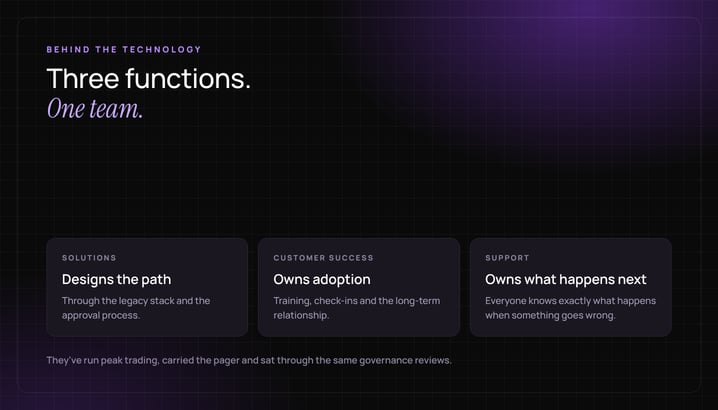
When I think about what makes adoption work across APAC, it’s having solutions, customer success and support teams who act as one. Solutions designs the path through the legacy stack and the approval process. Customer success owns adoption, training and the long-term relationship. Support makes sure everyone knows exactly what happens when something goes wrong.
The teams that do this best have usually worked on the retailer side themselves. They’ve run peak trading, carried the pager and sat through the same governance reviews. That’s the standard I hold our team to, in Australia and as we work with more retailers across Southeast Asia.
Partner, not vendor
Old stacks, siloed teams and heavy governance aren’t reasons to wait. They’re the reality of every large retailer. The right partner plans around them instead of pretending they don’t exist.
If you’re asking these same three questions inside your organisation, I’d love to compare notes. Which one is the hardest for you?
Angelo David is Senior Solutions Architect & APAC Lead at Zitcha. If your team is working through legacy integrations, internal alignment or a governance review, let’s talk.
As a leader in this rapidly growing space, we can bring you up to speed.
Mauris lectus eleifend quis sapien at. A eget ultrices bibendum ultrices. Odio adipiscing eget sed feugiat donec. Aliquam nec placerat nibh urna. Integer ac purus, mattis felis mi. Praesent ipsum dolor dui, nisl vitae egestas netus et urna. Ridiculus diam fusce nibh nunc. Urna vestibulum quisque odio morbi elementum consequat pellentesque sociis. Augue eget amet, urna, lobortis. Risus viverra mi duis at vestibulum. Ipsum ornare sed facilisis velit suspendisse. Gravida nunc, ullamcorper sit etiam integer. Vitae duis eu ac sit laoreet tincidunt magna risus adipiscing.
This is an example of h3 in use as a quote. Mauris lectus eleifend quis sapien at. A eget ultrices bibendum ultrices. Odio adipiscing eget sed feugiat donec. Aliquam nec placerat nibh urna. Integer ac purus, mattis felis mi. Praesent ipsum dolor dui, nisl vitae egestas netus et urna. Ridiculus diam fusce nibh nunc.
As a leader in this rapidly growing space, we can bring you up to speed1.

As a leader in this rapidly growing space, we can bring you up to speed1.